


Getting older does not mean you are “supposed” to wake up in pain every morning.
For many people over 40, neck and shoulder discomfort after a full night of sleep has much more to do with pillow choice and sleeping position than with age alone.
If you constantly get out of bed feeling stiff, tight or “rusty” in your neck, it may be time to look more closely at what is happening with your cervical spine during the night.
Conteúdo
Why Your Neck Suffers During Sleep
We spend roughly a third of our lives sleeping. That is a long time for your neck to stay in the wrong position.
A few common problems show up again and again:
- Pillows that are too high push the head forward, bending the neck and compressing joints and muscles.
- Pillows that are too low or too flat let the head fall back or down, stretching the neck in an awkward angle.
- Old pillows lose shape and support, so the head sinks over the night and the neck never really rests.
The result is simple: your cervical spine is forced into a position it would never stay in voluntarily for seven or eight hours while you are awake. Muscles tighten to protect the joints, circulation is not ideal, and you wake up with stiffness, tension, headaches or shoulder pain.
Common “Sleep Mistakes” That Make Neck Pain Worse
You may recognize some of these habits:
- Sleeping with two pillows stacked, because it feels cozy at first.
- Keeping the same pillow for many years “because it’s my favorite”.
- Using decorative pillows that were never designed to support the cervical spine.
- Ignoring your sleeping position (side, back or stomach) when choosing a pillow.
These choices do not necessarily hurt in your twenties, but after 40 the neck becomes less tolerant of long periods in a bad position. What used to be “just a bit uncomfortable” turns into real pain or morning stiffness.
How an Ergonomic Pillow Can Help Your Neck
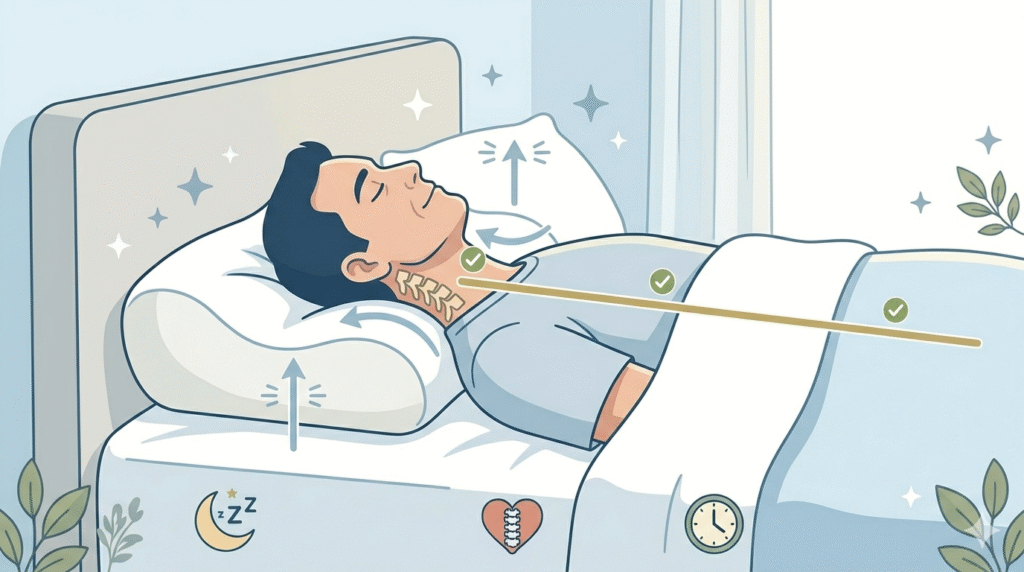
An ergonomic or cervical pillow is shaped to follow the natural curve of your neck and upper spine, instead of being a simple flat rectangle.
In practice, this means:
- There is a gentle contour where your neck rests, so the gap between your head and the mattress is filled.
- The pillow keeps your head in a more neutral position, not too high and not too low.
- Your shoulders are allowed to relax instead of being pushed up toward your ears.
Many ergonomic pillows use memory foam, which adapts to your shape and helps distribute pressure more evenly. The goal is not to “correct” you like a rigid brace, but to give your neck a stable, comfortable base to rest on while you sleep.
For a lot of people, especially after 40, this change alone can reduce morning stiffness and make it easier to move the head and shoulders when they wake up.
You can see a full explanation of how an ergonomic cervical pillow works here.
Signs Your Pillow Is No Longer Supporting You
You do not need an X‑ray to know that your pillow might be part of the problem. Some everyday signs are:
- You wake up rubbing your neck or rolling your shoulders almost every morning.
- You feel better after a hot shower or gentle stretching, which suggests muscles were tight all night.
- Your pillow looks visibly flat, lumpy or deformed in the area where you rest your head.
- You often fold your pillow, hug another one, or put your hand under your head to try to get more support.
If this sounds familiar, your body is sending clear signals that something about your night‑time support is not working.
Choosing Better Support After 40
When you look for a new pillow, especially if you are 40+, 50+ or 60+, it helps to focus on a few key points:
- Height: The pillow should match your shoulder width and keep your neck in line with your spine when you lie on your side or back.
- Shape: Contoured, ergonomic designs tend to support the natural curve of your neck better than flat pillows.
- Material: High‑quality memory foam or similar materials that do not collapse completely under the weight of your head often provide more consistent support through the night.
- Position: If you sleep on your stomach, almost any pillow will strain your neck. Whenever possible, moving gradually toward side or back sleeping can help.
You do not need something extremely hard or “medical-looking”. Many modern ergonomic pillows are soft to the touch but keep their structure enough to protect your neck.
Give Your Neck Time to Adapt
It is also important to be realistic: if your neck has spent years sleeping in one type of position, it may need a little time to adapt to a healthier one.
When you change to an ergonomic pillow:
- Expect a few nights of “strange” feeling as your muscles adjust.
- Use the new pillow consistently for at least one to two weeks before deciding if it works for you.
- Make sure your neck is on the curved support area, not on the very top edge.
- If you sleep on your side, choose the height side that keeps your spine as straight as possible.
In many cases, people notice that the initial unfamiliar feeling gradually gives way to a deeper sense of support and less pain in the morning.
A Simple First Step Toward Better Mornings
If you are tired of waking up with a heavy, stiff neck, you do not necessarily need to start with strong medications or complicated treatments. Sometimes the first step is simply making sure your neck is not fighting against your pillow every night.
I prepared a dedicated page about ergonomic cervical pillows, explaining in more detail how this type of design supports the neck, who can benefit the most (especially after 40) and what to expect when you make the change.
It might be a small change in your routine, but for many people it becomes the difference between starting the day already cansada/o e travada/o – or finally waking up with a lighter neck and more energy.